Japanese Pokémon cards: what makes them different, and how to read one
Someone has handed you a card and you cannot read a single word on it. Good news, and it is bigger than it sounds: almost everything that matters on a Pokémon card is a number, and numbers do not need translating. The HP, the damage, the Energy cost, the Retreat cost — all of it is already legible to you. Here is the rest of the card, plus the thing people really want to know about Japanese cards: how far ahead of us they are, and by exactly how much. We measured it on 23 expansions, one pair at a time.
- Japan ships first, and we counted by how much: 56 days, which is 8 weeks. That is the median across 23 matched expansions, and the individual gaps run from 0 days (30th Celebration) all the way to 98 (151).
- A Japanese set is a smaller product than ours. 28 Japanese sets became 22 expansions here, and 5 of those were built by merging two or more. In numbers: 2,769 numbered cards over there became 3,097 numbered cards here.
- The numbers on a Japanese card are the numbers on the English card. Same HP, same damage, same Energy cost. Only the sentences have to wait for the translation.
- Are they worth more? Being Japanese is not what makes a card valuable. In Japan the Japanese print is the ordinary one, and what makes a card scarce is the rarity tier stamped on it.
Japan first, by 56 days — and here is every pair
Every international expansion is built out of one or more Japanese sets, and the Japanese ones come out first. On the 23 pairs where we know both dates, the median gap is 56 days, about 8 weeks. The table below gives you each pair on its own line rather than one average to trust blindly.
Read the gap column before you take the median too seriously. 12 of the 23 releases landed between 50 and 70 days after Japan, which is a tight enough cluster to plan around. But the fastest of them took 0 days and the slowest took 98. The publisher has changed its rhythm before, and it will change it again.
The two card-count columns are the part you will not find anywhere else, and they answer a question people ask constantly without quite putting it into words: is a Japanese set the same thing as ours? No. It is smaller and it comes more often. Across every matched pair, 2,769 numbered Japanese cards turned into 3,097 numbered cards here.
Which is why the numbering never lines up, and why card 33 of a Japanese set is not card 33 of the English one. Ever. 5 of our expansions were assembled out of several Japanese sets at once, cards get left out, and the whole thing is renumbered from one. If you want to find the English version of a card, look up the Japanese set code printed at the bottom (SV10, M5, M6…) in the table, get the expansion it became, then find your Pokémon inside that expansion.
Right now 1 Japanese sets are on sale over there with no international release announced. Those cards are real. People are buying them and playing with them today, and going by the gap above they will land here in roughly two months. That is the whole reason we read Japan every night.
| Japanese set | Out in Japan | Cards in Japan | Set | Released | Cards here | Gap |
|---|---|---|---|---|---|---|
| M6aJP | 16 September 2026 | — | 30CEN 30th Celebration | 16 September 2026 | 128 | 0 days |
| M5JP Abyss Eye | 22 May 2026 | 81 | PBLEN Pitch Black | 17 July 2026 | 84 | 56 days |
| M4JP Ninja Spinner | 13 March 2026 | 83 | CRIEN Chaos Rising | 22 May 2026 | 86 | 70 days |
| M3JP Nihil Zero | 23 January 2026 | 80 | POREN Perfect Order | 27 March 2026 | 88 | 63 days |
| M2aJP MEGA Dream ex | 28 November 2025 | 193 | ASCEN Ascended Heroes | 30 January 2026 | 217 | 63 days |
| M2JP Inferno X | 26 September 2025 | 80 | PFLEN Phantasmal Flames | 14 November 2025 | 94 | 49 days |
| M1LJPM1SJP Mega Brave + Mega Symphonia | 1 August 2025 | 126 | MEGEN Mega Evolution | 26 September 2025 | 132 | 56 days |
| SV11BJP Black Bolt | 6 June 2025 | 174 | BLKEN Black Bolt | 17 July 2025 | 86 | 41 days |
| SV11WJP White Flare | 6 June 2025 | 86 | WHTEN White Flare | 17 July 2025 | 86 | 41 days |
| SV10JP Glory of Team Rocket | 18 April 2025 | 98 | DRIEN Destined Rivals | 30 May 2025 | 182 | 42 days |
| SV9JP Battle Partners | 24 January 2025 | 100 | JTGEN Journey Together | 28 March 2025 | 159 | 63 days |
| SV8aJP Terastal Festival ex | 6 December 2024 | 187 | PREEN Prismatic Evolutions | 17 January 2025 | 131 | 42 days |
| SV8JP Super Electric Breaker | 18 October 2024 | 106 | SSPEN Surging Sparks | 8 November 2024 | 191 | 21 days |
| SV7JP Stellar Miracle | 19 July 2024 | 102 | SCREN Stellar Crown | 13 September 2024 | 142 | 56 days |
| SV6aJP Night Wanderer | 7 June 2024 | 64 | SFAEN Shrouded Fable | 2 August 2024 | 64 | 56 days |
| SV6JP Mask of Change | 26 April 2024 | 101 | TWMEN Twilight Masquerade | 24 May 2024 | 167 | 28 days |
| SV5KJPSV5MJP Wild Force + Cyber Judge | 26 January 2024 | 142 | TEFEN Temporal Forces | 22 March 2024 | 162 | 56 days |
| SV4aJP Shiny Treasure ex | 1 December 2023 | 190 | PAFEN Paldean Fates | 26 January 2024 | 91 | 56 days |
| SV4KJPSV4MJP Ancient Roar + Future Flash | 27 October 2023 | 132 | PAREN Paradox Rift | 3 November 2023 | 182 | 7 days |
| SV2aJP Pokémon Card 151 | 16 June 2023 | 165 | MEWEN 151 | 22 September 2023 | 165 | 98 days |
| SV3JP Ruler of the Black Flame | 28 July 2023 | 108 | OBFEN Obsidian Flames | 11 August 2023 | 197 | 14 days |
| SV1aJPSV2PJPSV2DJP Triplet Beat + Snow Hazard + Clay Burst | 14 April 2023 | 215 | PALEN Paldea Evolved | 9 June 2023 | 193 | 56 days |
| SV1SJPSV1VJP Scarlet ex + Violet ex | 20 January 2023 | 156 | SVIEN Scarlet & Violet | 31 March 2023 | 198 | 70 days |
A Japanese card blown up, field by field
Start with the numbers, because they need no translation whatsoever. HP top right, the Energy cost as coloured circles to the left of each attack, the damage to the right of it, Weakness and Retreat along the bottom. That is most of what the card does in a game, and you can already read all of it.
Get a Japanese card out and put it next to the screen. On the picture below we have placed fourteen markers, one per field, and each one tells you what lives in it. Walk them in order once, then look back at your own card. Same fields, same places.
The card we are showing is a plain one, on purpose. It has the ordinary frame, the one almost every card in the game is printed with. The big showy cards, the ones where the art runs off the edges, lay their text out differently. Those are not where you learn to read a card. Come back to them when you can find the fields with your eyes shut.
Two markers are worth stopping on straight away. The evolution stage, top left, decides whether you can put the card down at all or need the one below it in play first. And the set code, printed in a small black box right at the bottom, is what lets you find the English set this card belongs to.
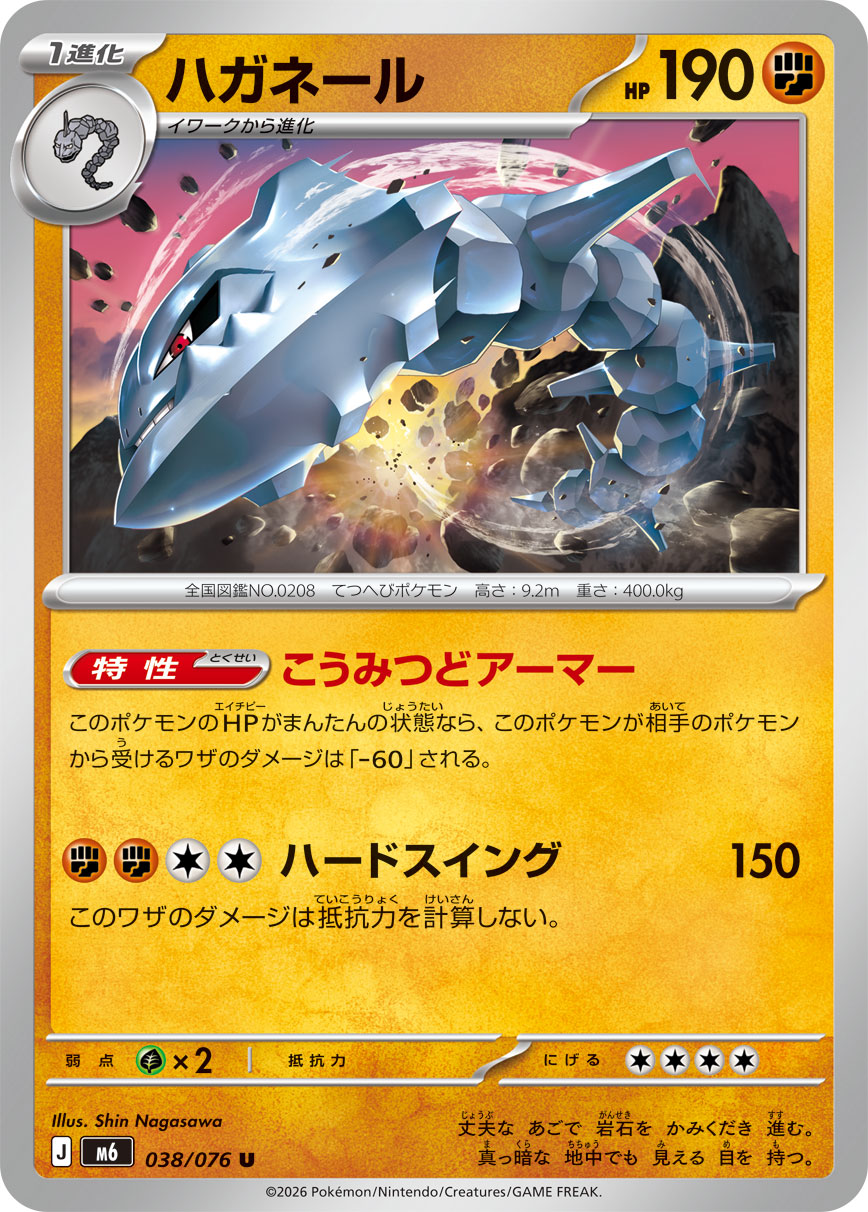
- 1The evolution stageIt tells you whether you can put the card straight down, or need the one below it first.
- 2The card nameIn Japanese, of course. It is about the only place where a translation is any help.
- 3The HPThe damage the card soaks up before it falls. That number needs no translating.
- 4The typeThe little circle next to it. It decides which Energy the card runs on.
- 5The Ability特性. Something that works without attacking. When you see those two characters, stop.
- 6The attack costCount the circles. That is how much Energy you attach before you can swing.
- 7The attack nameAnd under it, what the attack does on top of the damage. Games turn on that line.
- 8The damageThe big number on the right. Hold it up against the HP of the Pokémon facing you.
- 9The Weakness弱点. Against that type the card takes double. A whole trade can tip on it.
- 10The Resistance抵抗力. Damage taken off against one type. Most of the time the box is empty.
- 11The Retreat costにげる. That much Energy discarded to send the card back to the bench.
- 12The set codeThe small black box. It is how you find the English set that matches.
- 13The card numberIts place in the set, then the set total. The English number will be a different one.
- 14The rarityThe letter after the number. It tells you how hard the card is to pull.
What is on a Japanese card, field by field
The table below walks one real Japanese card line by line: what is printed on it, what that comes to on this particular card, and where to look for it. The card we take is the biggest Pokémon in the Japanese set we are reading right now, so it changes on its own the day the next set lands.
The card below is a real one. It is the highest-HP Pokémon in M6A (30th CELEBRATION), the Japanese set we are reading right now, which came out over there on 16 September 2026 with 111 cards in it. When the next set lands, this example changes on its own, because we read the new one and pick its biggest Pokémon.
Three fields do need words, and they are the same three every time: the name, the attack names, and the effect text. Everything else is digits and symbols that are printed identically on the card that will ship here. That is worth holding on to — when you look at a Japanese card, you are looking at the exact numbers of the English card, two months early.
In M6A, 10 cards carry the Pokémon ex rule: knock one out and your opponent takes 2 Prize cards rather than one. That is the whole trade-off of a big attacker, and it is written on the card in a line most people skip.
One honest note about the English names on this page. 111 of the 111 cards in M6A have no official English name yet, because the set has not shipped here. What you see for those is our own translation, holding the spot, and we mark it as one. The numbers are certain. The sentences are less so.
| On the card | What it says |
|---|---|
| ボーマンダex | Salamence ex |
| Number | 088/103 |
| HP | 330 |
| Stage | 2 進化 · Stage 2 |
| Type | Dragon |
| Attack | とどろくよびごえ · Roaring Call |
| Damage | — |
| Attack cost | Colorless |
| Weakness | -- |
| Resistance | — |
| Retreat | 2 |
The handful of Japanese words that come back on every card
There are about six of them and they cover nearly everything. Learn these and you can sort a pile of Japanese cards without knowing a word of Japanese. Each line below is counted on M6A itself, so you can see how often you will actually meet it.
The evolution stage sits in the top left corner and it is the one worth learning first, because it decides whether you can put the card down at all. A Basic goes straight from your hand to the bench. Anything else needs the card underneath already in play.
特性 above the attacks means Ability, and it is usually the reason a card is good. An Ability works without attacking, which means it can work on the turn you put the Pokémon down, and it can work from the bench. Cards with a big attack get talked about. Cards with a quiet Ability win tournaments.
| Japanese | What it means | Where it sits |
|---|---|---|
| たね | Basic — you can put this one straight down from your hand | Top left · 77 of the 111 cards in M6A |
| 1 進化 | Stage 1 — the card underneath has to be in play before you can put it down | Top left · 14 of the 111 cards in M6A |
| 2 進化 | Stage 2 — the card underneath has to be in play before you can put it down | Top left · 9 of the 111 cards in M6A |
| 特性 | Ability — it works without attacking, and it is often the real reason to play the card | Above the attacks · 15 of the 111 cards in M6A |
| ポケモンex | Pokémon ex — when it is knocked out, your opponent takes 2 Prize cards instead of one | Small print under the attacks · 10 of the 111 cards in M6A |
Are Japanese Pokémon cards worth more?
Not because they are Japanese, no. In Japan the Japanese print is the ordinary one, made in enormous quantities. What makes a card scarce is the rarity tier stamped on it, bottom right, and how many people are after it this week.
You will not find a figure on this page, and that is deliberate. What a single card fetches moves week by week, and a cold guide would be wrong about it between two visits. What this page gives you instead is the part that holds still: when the Japanese set came out, how many cards it holds, and which international expansion it became.
There is one thing worth straightening out before you trade, because it costs people money every week. A card is not rare because it is Japanese. In Japan the Japanese version is the ordinary one, printed in enormous quantities. What makes a card scarce is its rarity tier and the size of its print run, and the rarity is stamped on the card itself, bottom right.
The other half of that, and it cuts the other way: some Japanese cards genuinely never ship here. Promos in particular follow their own numbering and have no one-to-one twin. So « Japanese » on its own tells you nothing about value, in either direction, and anyone who tells you otherwise is selling something.
Buying one: the three things to check on a listing
Check the set code, the collector number, and the letter in the little box at the bottom left. Those three together identify a card completely. A photo of the front does not, because the same Pokémon has been printed many times with different text.
The set code sits at the bottom of the card next to the number. It is what lets you look the card up in the table above and find out what it becomes here, and when. If a listing does not show it, ask for it before you pay. Someone selling in good faith will send you a photo in a minute.
The collector number tells you which card of the set it is, and it is the only way to be sure two listings are the same card. Japanese sets are small, so the numbers are small too, and a card numbered above the set total is one of the extras printed past the official numbering.
The letter in the box decides whether the card is legal in Standard, and it is printed on the Japanese card exactly as it is on ours. A Japanese card whose letter has rotated out of the format is no more playable than an English one with the same letter. We wrote a whole page on that letter, and it is worth reading before you spend anything.
Can you actually play a Japanese card in a tournament?
That is for the tournament organiser to decide, and they are the ones to ask. Ask while you are still building the deck. The morning of the event is too late to be hunting for four replacement cards.
We are not going to give you a ruling on this. Reading a tournament rulebook and telling you what it permits is somebody else's job, and getting it wrong would cost you a match. What we can give you is the three things you need to ask the question properly.
First, on Pokémon TCG Live the question does not arise. You play with the client's own cards, in your own language, and there is nothing Japanese to put in a deck. This page is only useful there for seeing what is coming.
Second, as far as the rules of the game go, a Japanese card and its international version are the same card. Same HP, same attacks, same costs. If an organiser allows it, you are not playing a stronger card. That is usually why a translation is asked for alongside it, so your opponent can read what the thing does.
Third, legality in Standard is decided by that letter at the bottom left, not by the language the card is printed in. Check the letter first. It is the answer to a different question than the one the organiser answers, and people mix the two up all the time.
This list fills itself in. The moment a set lands in Japan and we manage to read its cards one by one, it shows up here with the number we got through. It's our week's work, put up as it is.
Questions people ask
- How do you read a Japanese Pokémon card?
- Start with the numbers, because they need no translation: HP top right, Energy cost as coloured circles to the left of each attack, damage to the right of it, Weakness and Retreat along the bottom. That is most of what the card does in a game. What is left is the name, the attack names and the effect text, and the glossary above covers the handful of Japanese words that come back on every single card.
- How much earlier do Japanese Pokémon cards come out?
- About 56 days, which is 8 weeks. That is not a feeling, it is the median measured across the 23 expansions where we know both release dates. The individual gaps run from 0 days to 98, so the table above gives each expansion its own figure instead of one average.
- Are Japanese Pokémon cards worth more than English ones?
- Not for being Japanese, no. The language on its own does not make a card rare. In Japan the Japanese version is the ordinary one and it is printed in huge numbers. Rarity is decided by the rarity tier, which is stamped on the bottom right of every card, and by how many were printed.
- Is a Japanese set the same as an English set?
- No, and it is worth knowing before you try to complete one. Japanese sets are smaller and ship more often. Across the pairs we matched, 28 Japanese sets became 22 expansions here, 5 of them assembled from more than one Japanese set, and 2,769 numbered cards over there became 3,097 here. The numbering is redone from scratch, so card numbers never match between the two.
- Can I use Japanese cards in a Pokémon TCG tournament?
- The tournament organiser decides that, and we do not give rulings — reading the rules and telling you what they allow is not our job. Ask early, while you are still building the deck. Two things to know when you ask: for the rules of the game it is the same card, and whether it is legal in Standard is decided by the letter at the bottom left rather than by the language.
- Does poko use Japanese cards when it analyses my game?
- Only if you ask it to, in your settings. Some cards land in Japan two months before they reach us, and we translated their text ourselves: the numbers are solid, the sentences less so. Left alone we keep them out. Turn them on and the report tells you which ones showed up in your game, so you know what our reading rests on.
Where all of this comes from
The gap between the Japanese and international releases is measured on 23 matched expansions, checked pair by pair, and we give the median rather than the average because two near-simultaneous releases would drag an average down. Card counts on both sides are the official numbering published for each set, read off poko's own set table, which is assembled from the public TCGdex API for the international sets and from the publisher's Japanese database for the Japanese ones, on 21 September 2026. The values on the example card — HP, Energy cost, damage, stage, Prize rule — are read card by card from that Japanese database and depend on no translation. Where a pairing could not be verified, the cell stays empty instead of holding a guess. There are no prices on this page: we have none.
These pages are about the same corner of the game. If you came away from this one still wondering about something, start with one of them.
- ReadRarity symbols, countedThe symbol at the bottom of your card tells you which pile it came out of. Everyone shows you the symbols. We counted how many cards carry each one, set by set, so you can tell at a glance whether the card in your hand is one in three or one in eight hundred.
- ReadSet symbols and codesThree capital letters on a decklist, a small symbol at the bottom of a card. Here is every set with its printed code, its release date, how many cards it holds — and the Japanese set it was built from, which is the column nobody else publishes.
- ReadUpcoming sets and release datesThe next expansion already exists — it has been on sale in Japan for weeks. Here is what is in it, and the window our measured Japan-to-here gap puts it in. Plus every past release with its real date on both sides.
- ReadWhat to buy, countedBooster box, Elite Trainer Box, League Battle Deck: every shelf wants your money and none of them tells you what the decks people actually play are made of. We count that, off real tournament lists, and we tell you which product can even contain what you need.
- ReadWhat the boxes are worthWhat does a booster box, a bundle or an Elite Trainer Box cost? We take down the price of five thousand boxes every day and rank the priciest. And separately, the ones whose price rests on nothing solid — and why.