What your free account gets you
Your account costs nothing. Your email address is all you need to open one. It’s mainly for your collection: you add your Pokémon cards, then we tell you what each one is worth.
It also shows you a card’s biggest drop, right under its price chart, then the cards that moved the most on the market.
We email you a link. One click and you’re in.
Your album
You can also tick off your cards one after another on a set’s page: one “+” on each card you have, and your album shows you straight away which ones you’re missing.
Your collection and what it’s worth
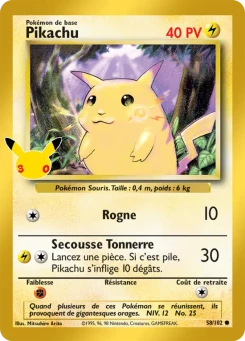
30th Celebration
€24.00 each: the cheapest of 49 listings in our check on 29 November, from sellers in the European Union.
Open a card’s page and set it to match your copy. Then tap “Add to my collection”, and the card goes into your collection.
Setting the page means telling it what changes your copy’s price:
- Its language. A Japanese card doesn’t cost the same as the same card in French.
- Its condition, meaning how worn it is. It runs from Mint, with no wear at all, to Poor, damaged beyond wear. Near Mint, one step below, only allows a few tiny white marks on the edges or corners.
- Its version, when it has one: a first edition, with the stamp from the first print run, or a reverse holo, where the whole card shines except the artwork.
The button then asks how many you have. You can also note the price you paid for one copy, and when you bought it.
We check card prices in French, English, German, Japanese, Korean, Traditional Chinese and Simplified Chinese. A card in another language still goes into your collection, just without a price.
For a pack or a booster box nobody has opened yet, it’s the same button on its page. We check their prices in French, Japanese and Korean: those are the languages you can pick.
How we count your collection
Each line in your collection is called a lot. It’s one copy, set the way its page is set, with how many you own. The same copy bought at two different prices makes two lots.
For each lot, we show the lowest price the same copy was listed at in our latest check, which is the price you see on its page. A check is when we go through a card’s listings. We write down what sellers are asking, with the day and time.
At the top of your collection, we add up everything that has a price. We also tell you which checks those prices come from. These are the prices sellers ask, before shipping. If you sell, you pay fees, and you often sell a little below.
A collection holds up to 10,000 lots. A lot, up to 9,999 copies.
What you read under a card’s price chart
When we’ve been checking a card for a few days, its page shows a chart of its price. Signed in, you read two things right under it that are easy to miss when you just look at the chart.
Its biggest drop
Over the period you’re looking at, we find where its price fell furthest after a high. You read the day and price of the high, then of the low. We add how much it fell.
The day it breaks out of its range
Its range is the gap between the lowest and highest price it had the month before. When its latest price goes above or below anything from that month, we tell you, with both ends of the range.
Why some charts have nothing underneath
We only read days when at least 10 listings for that card were up for sale, in the condition you’re looking at. With fewer, one listing coming or going is enough to move the price: anything we read would mean nothing. When a chart has no drop or breakout to talk about, nothing shows up under it.
The sealed products that moved the most
Sealed products are packs and boxes nobody has opened yet. They have lists of their own, and you read the first 3 in each. Everyone can see how many go up and how many go down.
What pokoPLUS adds to your account
Everything your account opens stays free. pokoPLUS adds these readings on top.
- Listings gone for good
- Your alerts, in a morning email
- Every list of the card market
- Indexes by Pokémon and by illustrator
- The whole sealed market
- Sealed indexes
- How your collection moved
- What you’d get back if you sold
How signing in works
- You type your email address. Use one you actually read, because that’s where the link goes.
- We send you a link. It only works once. After an hour, it stops working.
- You click it in the same browser you asked from. You’re in.
There’s no password to make up or remember: your inbox is what proves it’s really you.
Your collection only shows up on your account. What we keep of it, and why, is written on our Privacy page.